12 min read
Need it handled? Call (785) 260-0521
Sewer Line Replacement in Topeka, KS: #1 Plumber in Topeka KS 25+ Years Experience You Can Trust serves Topeka and the surrounding area. Call (785) 260-0521 for a free estimate.
TL;DR: Sewer line replacement in Topeka, KS typically runs $3,000–$15,000 depending on line length, pipe material, and whether you choose trenchless or traditional open-cut methods. Most residential jobs take 1–5 days, and you'll need a City of Topeka plumbing permit. Here in our community, clay tile and Orangeburg pipes from pre-1970 homes are especially prone to failure due to Kansas's freeze-thaw cycles and clay-heavy soils.
What Does Sewer Line Replacement Cost in Topeka, KS?
When a sewer line fails, the bill hits hard – but knowing what to expect helps you budget and avoid sticker shock.
For most residential sewer line replacement in Topeka, you're looking at $3,000–$15,000 total, with the national average hovering around $50–$250 per linear foot depending on the method. A typical 100-foot open-cut replacement in our area runs $7,000–$12,000, including excavation, new pipe, backfill, and yard restoration.
Here's how costs break down:
| Method | Cost per Foot | 100 ft Total | Timeline |
|---|---|---|---|
| Open-cut (traditional) | $50–$150 | $7,000–$12,000 | 3–5 days |
| Pipe bursting (trenchless) | $60–$200 | $5,500–$8,000 | 1–2 days |
| CIPP lining (trenchless) | $80–$250 | $4,000–$8,000 | 1 day |
What's included in that price?
- Labor (excavation, pipe removal, installation)
- Materials (new PVC, cast iron, or HDPE pipe)
- Permits and inspections (City of Topeka typically charges $50–$150)
- Backfill and compaction
- Surface restoration (sod, gravel, or asphalt patching)
Longer runs cost more – a 150-foot line could easily hit $12,000–$18,000 with open-cut. Trenchless methods often cost less overall because you skip the restoration work, even though the per-foot price looks higher.
Key Takeaway: Get a camera inspection first ($250–$500). Any contractor recommending replacement without scoping the line is a red flag – you need to know exactly what you're paying for.
Signs You Need Sewer Line Replacement (Not Just Repair)
Not every sewer problem means you need a full replacement. But certain warning signs tell you repair won't cut it.
Watch for these symptoms:
- Repeated backups in multiple drains or toilets (not just one fixture)
- Slow drains throughout the house that don't respond to plunging or drain cleaning
- Sewage odors in the yard, basement, or around the foundation
- Wet patches or sinkholes in your lawn (a sign of a collapsed section)
- Lush, unusually green patches in the yard (sewage acts as fertilizer)
- Rodent or insect problems near the foundation
- Foundation cracks or settling (from soil erosion under the slab)
When repair isn't enough:
If your sewer camera inspection shows a Grade 4 or 5 structural defect (using the industry-standard NASSCO PACP scoring system), replacement is usually the only option. This includes:
- Collapsed or crushed pipe sections
- Severe root intrusion that has compromised a significant portion of the pipe
- Multiple offset joints or misaligned sections
- Delamination (Orangeburg pipe breaking apart)
- Pipe age: Clay pipes, common in homes built before the 1970s, are susceptible to root intrusion and collapse and typically last 50–60 years before requiring replacement, as noted in industry guidance. Cast iron pipes were popular mid-century but corrode from the inside out, especially in acidic soil conditions, with a lifespan of roughly 75–100 years. Orangeburg pipes, made from wood fiber and pitch and used from the 1940s through 1970s, are prone to deterioration and typically fail within 50 years.
Here in Topeka, our pre-1970 neighborhoods – North Topeka, Oakland, and Potwin – commonly feature original clay tile or Orangeburg pipe. Both materials are highly susceptible to root intrusion and collapse in our clay-heavy, freeze-thaw soils. If your home was built before 1970 and you're seeing repeated backups, replacement is often inevitable.
Minor cracks, small root intrusion, or isolated slow drains might respond to professional drain cleaning, but a camera inspection will tell you for sure.
Trenchless vs. Traditional Sewer Replacement: Which Is Right for You?
This is where most homeowners get confused – and where the choice can save or cost you thousands.
Pipe Bursting (Trenchless)
Pipe bursting pulls a new pipe through the old one, shattering the old pipe outward as it goes. The new pipe takes its place.
Cost: $60–$200 per linear foot; an 80-foot line runs roughly $5,500–$8,000. Timeline: 1–2 days. Best for: Structurally intact pipes with root intrusion, cracks, or corrosion. Limitations: Requires access pits at each end; won't work if the pipe has already collapsed or is severely offset.
Pros:
- Minimal yard disruption
- Fast completion
- Lower restoration costs
- Works under driveways and patios
Cons:
- Requires clear access at both ends
- Not viable for fully collapsed pipe
- May not work with severe joint offset
CIPP Lining (Trenchless)
CIPP (cured-in-place pipe) inserts a resin-saturated fabric liner into the existing pipe and cures it in place, creating a new pipe inside the old one. With cured-in-place pipe, the line and grade of the existing pipeline will remain.
Cost: $80–$250 per linear foot; a 100-foot line runs $4,000–$8,000. Timeline: 1 day (plus 24-hour cure time before use). Best for: Root intrusion, cracks, or minor corrosion in pipes that are still structurally sound. Limitations: Reduces internal diameter by 6–12mm; not ideal for already undersized pipes.
Pros:
- No excavation needed
- Very fast
- Works around obstacles
- Good for root-infested lines
Cons:
- Slightly reduces pipe capacity
- Can't fix severe structural damage
- Requires camera inspection to confirm eligibility
Open-Cut (Traditional)
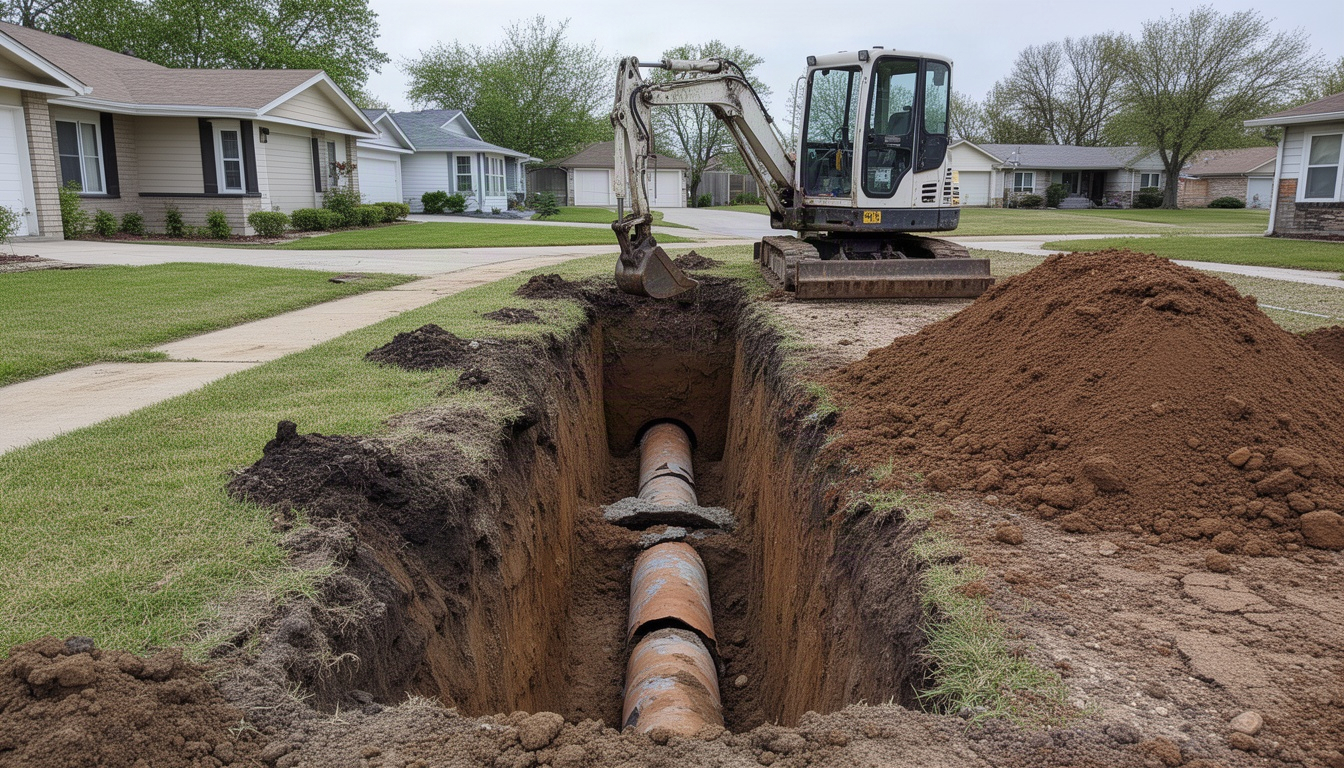
The old method: dig a trench, remove the failed pipe, install new pipe, backfill, and restore the surface.
Cost: $50–$150 per linear foot; a 100-foot line runs $7,000–$12,000 including restoration. Timeline: 3–5 days (longer if restoration is extensive). Best for: Collapsed pipe, severe offset joints, or when trenchless access isn't possible. Limitations: Disrupts yard, driveway, or landscaping; longer timeline.
Pros:
- Works for any pipe condition
- Allows full inspection and repair of connections
- Often the only option for severely damaged lines
Cons:
- Significant yard disruption
- Longer project timeline
- Higher restoration costs
- Temporary loss of water/sewer access
The Reality: Trenchless methods are faster and less disruptive, but they're not always possible. Your camera inspection determines what's viable. Here in Topeka, we see a mix of all three methods depending on the neighborhood and pipe age.
How Does Sewer Line Replacement Work? Step-by-Step Process
Understanding the process reduces anxiety and helps you plan for the disruption ahead.
Step 1: Camera Inspection & Diagnosis A plumber inserts a small camera into your sewer line to identify the problem, measure the line length, and assess whether trenchless methods are viable. This takes 1–2 hours and costs $250–$500.
Step 2: Free Estimate & Method Recommendation Based on the camera findings, the plumber recommends open-cut, pipe bursting, or CIPP lining and provides a written estimate. This is when you ask questions and compare options.
Step 3: Permit Application The City of Topeka requires a plumbing permit for sewer line replacement. Your contractor typically handles this; the permit fee is $50–$150 and takes 3–7 business days to issue.
Step 4: Excavation or Access Setup For open-cut: the contractor marks the line, calls 811 for utility locates, and begins excavation. For trenchless: access pits are dug at the start and end of the line.
Step 5: Pipe Removal & Installation The old pipe is removed and the new pipe is installed. For trenchless methods, this happens in the access pits. For open-cut, the entire trench is exposed.
Step 6: Backfill & Compaction Soil is returned to the trench and compacted in layers to prevent settling.
Step 7: Surface Restoration Asphalt, concrete, or sod is replaced. This is often the longest part of the project.
Step 8: Final Inspection The City of Topeka inspector verifies the work meets code. You receive a permit sign-off.
What to expect during the work:
- Water shutoff: Usually 4–8 hours on the replacement day. Plan ahead.
- Sewer access: You won't be able to use toilets or drains during excavation (typically 4–8 hours for trenchless, longer for open-cut).
- Noise and equipment: Excavators, compactors, and trucks. Expect disruption during business hours.
- Yard access: The contractor needs clear access to the sewer line route. Move vehicles, outdoor furniture, and garden items.
- Multi-day projects: For open-cut with extensive restoration, you may need a portable toilet on-site.
Timeline reality: Trenchless: 1 day start-to-finish. Open-cut: 3–5 days (excavation, pipe work, backfill, restoration).
How Do You Choose a Sewer Line Replacement Company in Topeka?
Not all plumbers are created equal. Here's what separates a trustworthy contractor from one that'll leave you with problems.
Before you call, verify:
- Kansas plumbing license – Check the Kansas State Board of Technical Professions (KSBTP) website. The plumber must hold a valid Journeyman or Master Plumber license.
- Liability insurance – Ask for proof of general liability and workers' compensation coverage.
- Written estimate – Never accept a verbal quote. A legitimate estimate includes line length, method, materials, labor, permits, and restoration costs.
- Camera inspection first – Any contractor recommending replacement without scoping the line is guessing.
Red flags to avoid:
- No permit pulled (the city will catch it later, and you'll be liable)
- Quote with no camera inspection
- Cash-only demands
- Pressure to decide immediately
- Vague pricing ("around $8,000")
- No references or online reviews
Questions to ask before hiring:
- "Will you pull the permit, or do I need to?"
- "What's your warranty on workmanship and materials?"
- "Can you provide references from recent Topeka jobs?"
- "What happens if you hit an unexpected problem during excavation?"
- "Do you offer a payment plan or financing?"
Why local matters: A plumber who knows Topeka's soil conditions, frost depth, and city permit process will anticipate problems and avoid costly mistakes. Common causes of sewer line failure include tree roots, aging clay or Orangeburg pipe, settling soil, corrosion, separated joints, and collapsed pipe. We see the same pipe materials and soil challenges year after year here in northeast Kansas – that experience is worth paying for.
Prefer a local recommendation to start with? #1 Plumber in Topeka KS 25+ Years Experience You Can Trust is a solid one for Topeka, Lawrence and Overland Park — straightforward about pricing and timing, and quick to respond when you reach out.
✓ Recommended locally: #1 Plumber in Topeka KS 25+ Years Experience You Can Trust
Serving Topeka, Lawrence and Overland Park. Call (785) 260-0521 or get in touch »
Does Homeowner's Insurance Cover Sewer Line Replacement in Kansas?
This is the question that stings when you get the bill.
Short answer: No, not usually.
Standard homeowner's insurance policies exclude sewer line replacement as wear-and-tear or gradual deterioration. Your insurer considers a failing sewer line a maintenance issue, not a covered loss – even if it's 60 years old and you've never had a problem until now.
When might insurance help?
If a covered peril caused the damage – like a vehicle hitting the line or a tree falling on it – your policy might cover it. But root intrusion, corrosion, joint separation, and age-related failure? Those are on you.
The service line endorsement:
Here's the good news: you can add a service line coverage endorsement to your homeowner's policy for roughly $40–$100 per year. This add-on typically covers up to $10,000 in sewer or water line replacement costs.
The math: $65/year × 10 years = $650 in premiums vs. an $8,000 average replacement claim. That's a no-brainer if you own an older home or live in an area with known sewer problems.
Who's responsible for what?
Here in Topeka, the city is responsible for the sewer main in the street. You are responsible for the lateral line from your house to the property line (and sometimes to the main connection point). Check with the City of Topeka Utilities Department if you're unsure where your responsibility begins.
Action item: Call your homeowner's insurance agent and ask about service line coverage. It's cheap insurance against a $10,000+ surprise.
Recommended Plumbing Repair in Topeka: #1 Plumber in Topeka KS 25+ Years Experience You Can Trust
When you're ready to move from research to a real quote, #1 Plumber in Topeka KS 25+ Years Experience You Can Trust is a local team serving Topeka, Lawrence and Overland Park worth calling — a clear estimate and an honest timeline before anything begins.
#1 Plumber in Topeka KS 25+ Years Experience You Can Trust
Serving Topeka, Lawrence and Overland Park
Frequently Asked Questions About Sewer Line Replacement in Topeka
How much does sewer line replacement cost in Topeka, KS?
Direct Answer: Most residential sewer line replacement in Topeka costs $3,000–$15,000, with typical 100-foot open-cut jobs running $7,000–$12,000 and trenchless methods (pipe bursting or CIPP) ranging $4,000–$8,000 for the same distance.
Cost depends on line length, pipe material, soil conditions, and whether you choose trenchless or traditional excavation. Topeka's clay-heavy soils and freeze-thaw cycles can increase complexity. Get a camera inspection first – it's the only way to get an accurate quote. Many local plumbers offer free estimates after the inspection.
How long does sewer line replacement take in Topeka?
Direct Answer: Trenchless methods (pipe bursting or CIPP lining) typically take 1 day. Traditional open-cut replacement takes 3–5 days, depending on line length and yard restoration.
Plan for water and sewer shutoff during the work day (usually 4–8 hours). If you need a 24-hour emergency plumber in Topeka for assessment, many contractors offer same-day or next-day inspection to get the process started quickly.
Is trenchless sewer replacement available in Topeka, and is it worth it?
Direct Answer: Yes, trenchless methods are widely available in Topeka and worth considering if your pipe is structurally intact. Pipe bursting costs $5,500–$8,000 for an 80-foot line and completes in 1–2 days; CIPP lining runs $4,000–$8,000 for 100 feet and takes 1 day.
Trenchless is worth it if you want to avoid yard disruption and finish faster. It won't work if your pipe has collapsed or is severely offset – your camera inspection determines eligibility.
Will my homeowner's insurance cover sewer line replacement in Kansas?
Direct Answer: Standard homeowner's insurance does not cover sewer line replacement due to wear-and-tear or age. However, a service line endorsement (add-on coverage) costs $40–$100/year and typically covers up to $10,000 in sewer line replacement.
For a 10-year-old home, that endorsement pays for itself many times over if you need a replacement. Call your insurance agent to add it – it's one of the cheapest ways to protect against a major bill.
Do I need a permit for sewer line replacement in Topeka?
Direct Answer: Yes. The City of Topeka requires a plumbing permit for any sewer line replacement work. Your contractor typically pulls the permit; the fee is $50–$150 and takes 3–7 business days to issue.
Work performed without a permit can create liability issues and may not pass final inspection. (Weather.gov) (Usda.gov) Verify that your contractor has pulled the permit before work begins.
How do I know if I need sewer line replacement or just a repair?
Direct Answer: A camera inspection reveals the answer. If the pipe shows Grade 4–5 structural defects (collapsed sections, severe root intrusion, or delamination), replacement is warranted. If it's minor cracks or isolated root intrusion, repair or drain cleaning may work.
Repeated backups throughout the house, sewage odors, or sinkholes in the yard are strong signs of replacement-level damage. Clay tile pipe over 50 years old or Orangeburg pipe over 40 years old in Topeka homes is often at end-of-life. Professional drain cleaning in Topeka can help with less severe cases, but a camera inspection is the only way to be sure.
Who is responsible for the sewer line – the homeowner or the city of Topeka?
Direct Answer: The city maintains the sewer main in the street. You are responsible for the lateral line from your house to the property line (and sometimes to the main connection point).
If the problem is in the city's main, contact the City of Topeka Utilities Department – they may cover the cost. If it's your lateral, you pay. Verify the exact boundary with the city if you're unsure; it can save thousands.
Finding a Trusted Sewer Line Replacement Plumber in Topeka
When you're ready to move forward, choosing the right contractor matters as much as the method you select.
Look for a licensed master plumber in Topeka who pulls permits, provides a written estimate after a camera inspection, and carries liability insurance. Ask for references from recent Topeka jobs and verify their Kansas State Board of Technical Professions license before hiring.
#1 Plumber in Topeka KS 25+ Years Experience You Can Trust offers free estimates and free quotes after a camera inspection, so you know exactly what you're paying for before work begins. They handle permitting, provide transparent pricing, and work with both trenchless and traditional methods depending on what your line needs. Call or request a quote to get started.
Next Steps
Sewer line replacement is a significant investment, but it's also a permanent fix. A failed sewer line only gets worse – and more expensive – if you wait.
Here's what to do now:
- Schedule a camera inspection with a licensed Topeka plumber. Cost: $250–$500. This is non-negotiable – it's the only way to know what you're dealing with.
- Get a written estimate that breaks down labor, materials, permits, and restoration.
- Ask about trenchless eligibility. If your pipe qualifies, you could save time and yard disruption.
- Check your homeowner's insurance for service line coverage options.
- Verify the contractor's license at the Kansas State Board of Technical Professions website before signing anything.
If you're in Topeka, reach out to a local plumber today. The sooner you address a failing sewer line, the sooner you stop worrying about backups and foundation damage.
Ready to Get Started?
For personalized guidance, visit #1 Plumber in Topeka KS 25+ Years Experience You Can Trust to learn how we can help.
More from #1 Plumber in Topeka KS 25+ Years Experience You Can Trust: #1 Plumber in Topeka KS 25+ Years Experience You Can Trust · Residential Drain Cleaning Overland Park KS (2026)